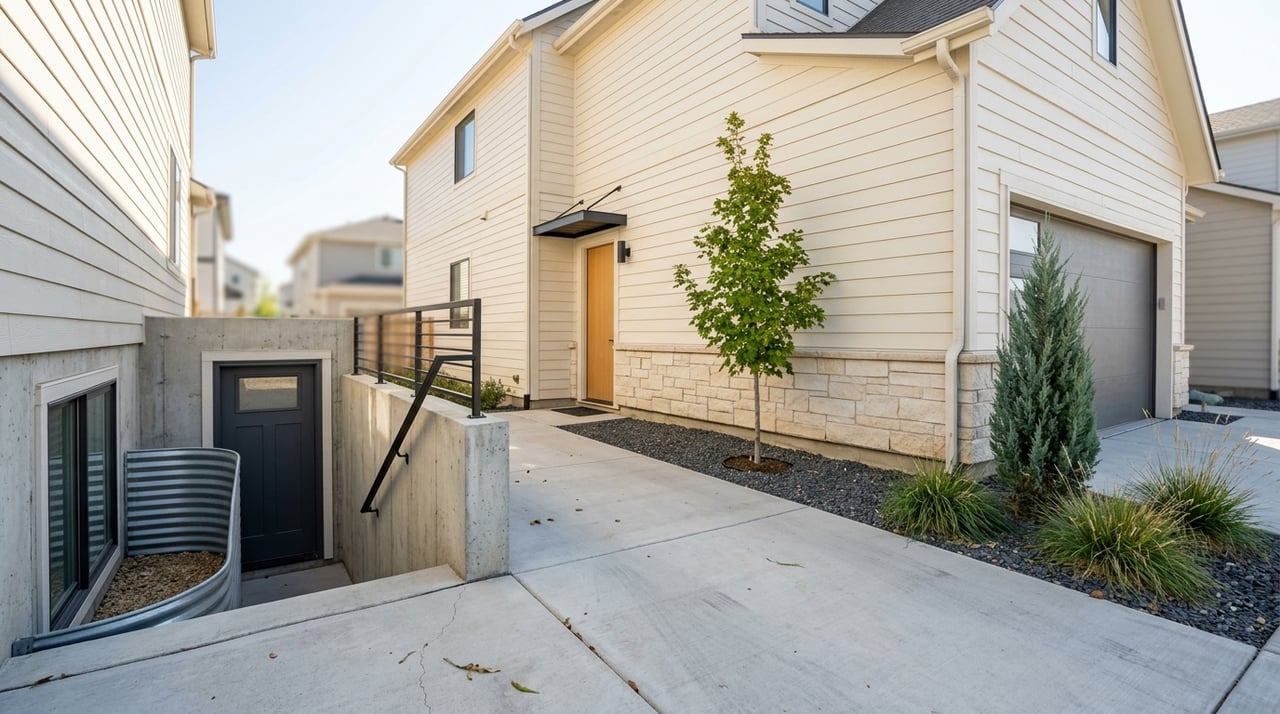
Riverton Basement Apartment Rules and ADU Basics
May 21, 2026
May 21, 2026
If you are eyeing a Riverton home and hoping a basement apartment or backyard unit can help with the mortgage, one detail matters more than the fresh finishes: is it actually legal to rent? That question trips up many buyers because a finished basement is not automatically a compliant income unit. In Riverton, house hacking can work well, but only when the space meets both Utah and city rules. Let’s break down the basics so you know what to look for before you count on rental income.
House hacking usually means living in one part of a property while renting out another part to offset your housing cost. In Riverton, that often points buyers toward basement apartments or accessory dwelling units, also called ADUs.
Utah law sets the baseline for internal ADUs, which are units created within the footprint of the main home for long-term rentals of 30 consecutive days or more. Riverton adds its own local rules on owner occupancy, parking, entrances, size, registration, and permits. That means a space can look rent-ready and still fall short of what the city requires.
Riverton allows ADUs in single-family zones and permits only one ADU per lot. The unit cannot be sold separately from the main home or parcel, which is important if you are thinking long term about value and use.
The city allows several ADU paths. A unit can come from converting existing living area, adding on to a single-family home, converting a detached accessory building, or building a new accessory building.
For basement house hackers, the most relevant category is the internal ADU. Under Utah’s baseline, an internal ADU is inside the footprint of the primary dwelling and intended for long-term rental use. In simple terms, a basement apartment may qualify, but only if it meets local code and follows the approval process.
This is one of the easiest places for buyers to get misled. Riverton treats a guesthouse differently from an ADU.
A guesthouse is for occupants of the main home or their nonpaying guests. It cannot be leased independently and cannot include kitchen or cooking facilities. So if you see a detached structure marketed as flexible space, do not assume it can produce rental income.
Riverton requires an owner occupant on the property, except for limited temporary absences. For many buyers, this is the biggest practical difference between a typical investment idea and a true house-hacking setup.
In other words, Riverton’s ADU framework is built around you living on the property while renting the extra unit. If your plan is to move out and keep both spaces rented without meeting the city’s occupancy standard, that deserves a closer review before you buy.
In Riverton, parking is not a small detail. It is one of the main filters that determines whether a home can support a legal ADU.
The city requires at least one dedicated on-site parking space for the ADU. Tandem parking is not allowed, which means one car cannot be blocked in by another and still count toward compliance.
An existing driveway may satisfy the requirement if the usable parking area is at least 20 feet deep by 8 feet wide. For buyers touring homes, this is worth checking early because a beautiful basement suite does not help much if the parking layout does not work under city rules.
Entrances shape both function and compliance. For an ADU inside the house, Riverton allows an existing entrance or a side or rear entrance.
That flexibility can help with basement conversions, especially in homes where below-grade access already exists. The city also allows basement stairs to encroach into the side yard, which can make some basement layouts more feasible.
Detached ADUs have more specific entrance rules. The entrance must face the alley, public street, or rear facade of the main house, or be located on the side or rear property line with the required setbacks.
Not every extra living area can become a full ADU. Riverton places size limits on both internal and detached units.
For units inside the main house, the ADU may not exceed 40% of the gross square footage of the single-family dwelling. Attached garage square footage generally does not count, unless the ADU is in a basement with habitable space below the garage.
Detached ADUs are capped at 650 square feet. They also have to follow accessory-building setback and height rules, so a detached unit typically involves more design and site-planning constraints than a basement conversion.
This is where buyers need to slow down. A finished basement is not the same thing as a legal rental unit.
Riverton requires an ADU permit in addition to any building permits. The application must include a scaled site plan, scaled floor plans, proof of ownership and permanent residency, and a recorded deed restriction that acknowledges owner occupancy.
The city also states that no ADU permit or certificate of occupancy may be issued until the work is complete, inspected, and all requirements are met. The registration fee listed in the code is $175.
If a basement apartment looks rentable but does not have the permit and certificate-of-occupancy trail to support it, you should treat it as a compliance risk. It may still become legal later, but it should not be treated as guaranteed income during your home search.
That distinction can affect your budget, your financing comfort level, and your renovation timeline. A smart buying strategy is to underwrite the home based on what is documented, not on what a seller or listing description assumes.
Riverton does not have a public basement-suite rent index, so citywide apartment data is the best public proxy. As of May 2026, available market trackers show a range rather than one single number.
Here is a simple snapshot of public rent estimates for Riverton:
| Unit Type | Public Rent Range |
|---|---|
| 1-bedroom | About $1,335 to $1,495 |
| 2-bedroom | About $1,808 to $1,895 |
| Overall apartment average | About $1,978 |
Because these sources vary, it is more realistic to think in ranges than in exact numbers. That is especially true for ADUs, where layout, entrance privacy, parking, and finish level can all affect what a renter may be willing to pay.
Using Realtor.com’s reported Riverton median listing price of $582,500, a 20% down payment would leave a loan amount of $466,000. At Freddie Mac’s reported 30-year fixed rate of 6.37% on May 7, 2026, the principal-and-interest payment would be about $2,906 per month.
Using the public rent figures above, a 1-bedroom at $1,495 would cover about 51% of that principal-and-interest payment. A 2-bedroom-style rent estimate in the $1,808 to $1,895 range would cover about 62% to 65%.
That is meaningful help, but it usually does not erase the full mortgage payment. House hacking in Riverton can improve affordability, but it works best when you go in with realistic expectations and verified numbers.
If you are shopping for a Riverton home with house hacking in mind, focus on these four checkpoints before you rely on future rent:
Confirm the unit type
Make sure the space is a legal ADU and not a guesthouse or informal basement finish.
Verify owner-occupancy compliance
Riverton requires an owner occupant on the property, except for limited temporary absences.
Check parking and entrance setup
Review whether the dedicated parking space, non-tandem requirement, and entrance placement match city rules.
Ask for the permit history
Look for the ADU permit, related building permits, inspections, and certificate of occupancy.
These four items can tell you a lot about whether the opportunity is ready now, needs work, or should be valued simply as extra living space rather than immediate rental income.
In Riverton, the best house-hacking opportunities are usually the ones that combine solid design with clean documentation. A basement with a separate entrance, workable parking, and a clear permit trail can be a very practical way to offset monthly housing costs.
The flip side is just as important. If a property only looks like an income producer but lacks the legal foundation, you may be buying a project rather than a plug-and-play rental setup.
That is why local guidance matters. When you understand the difference between a finished space and a compliant ADU, you can shop more confidently, price risk more accurately, and build a plan that fits how you actually want to live.
If you are exploring homes in Riverton and want help evaluating basement potential, detached ADU options, or the details that affect long-term value, Tyson Leavitt Real Estate can help you look at the full story before you make your move.
Stay up to date on the latest real estate trends.
Whether you’re just beginning your search or preparing for your next move, the Tyson Leavitt Group is here to guide you with expertise, integrity, and exceptional service. With deep-rooted knowledge of the Salt Lake Valley and surrounding areas, we’re ready to help you navigate every step of the journey with confidence and clarity. Explore the site, then reach out—we’d love to hear from you.
Tyson Leavitt Group | Cannon & Company
Tyson Leavitt
9089 S 1300 W, #130 West Jordan, UT 84088